WH Smith - Updated
It looks bad, but I'm more confident now.

WH Smith PLC (LSE: SMWH) is a UK-listed global travel concession operator.
I wrote them up not that long ago, but following the capital raise I felt I had to rewrite the piece and update the thesis.
Situation Summary
WH Smith is a ~£1.0bn Enterprise Value provider of travel retail and convenience solutions to a captive transit-hub customer base. In simple terms, captive air, rail and hospital passengers pass through WH Smith’s airside or platform infrastructure where they purchase high-margin convenience essentials, food and tech accessories under strict geographical exclusivity.
Over the past decade, a structural shift occurred: the company deprioritised and carved out its legacy UK High Street. Today, the asset is split between its high-growth North American division and its UK & Rest of the World (ROW) footprint.
WH Smith has clearly been a terrible story for investors thus far:
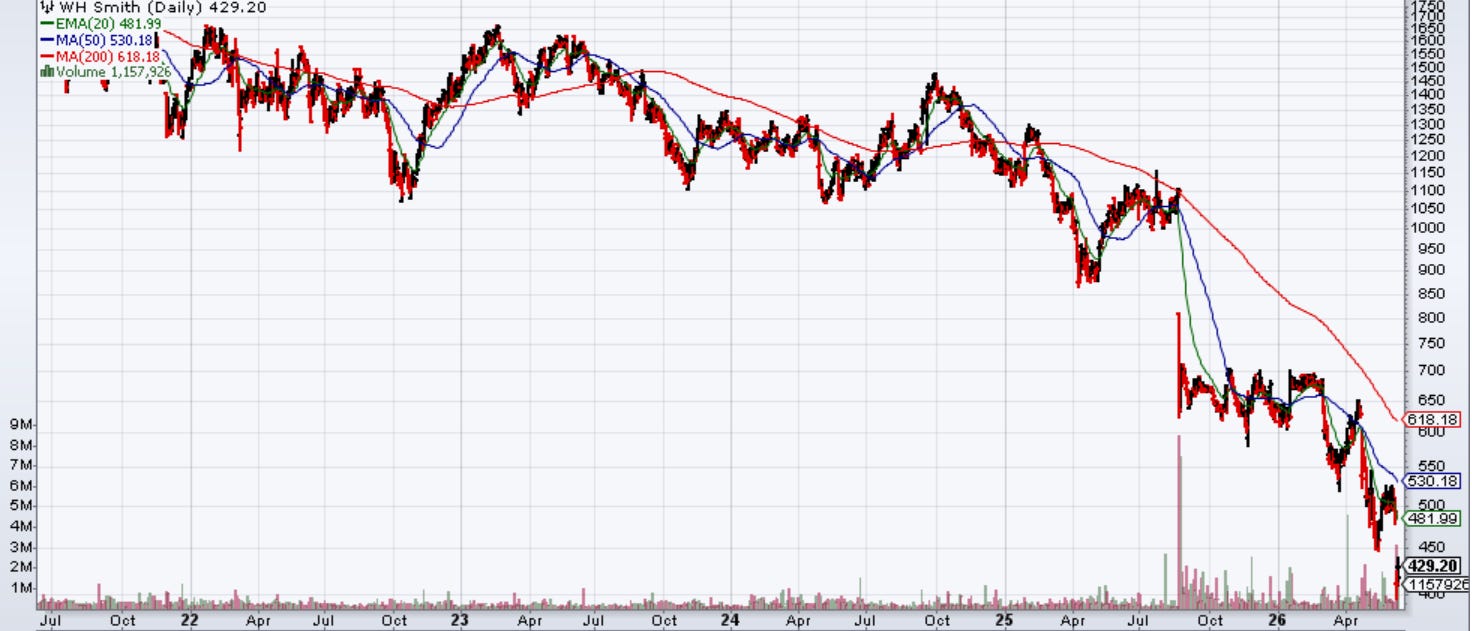
While underlying structural volume drivers have remained robust, recent financial performance has been severely impaired by severe macro headwinds, operational friction and an aggressive supplier-income accounting remediation program in its North American Resorts division.
In its June 10, 2026 trading update, the company issued a material profit warning, slashing its FY26 Headline Group Profit Before Tax (PBT) guidance to a range of £75m–£90m, down from initial expectations. Furthermore, an ongoing review of its underperforming InMotion tech brand and non-core Resorts footprints will trigger a substantial non-cash impairment charge of up to £150m for the full year.
Despite the defensive moat of travel concession infrastructure, WH Smith has seen its equity multiple severely compressed as investor focus shifted from asset quality to near-term cyclical headwinds - specifically, the ongoing conflict in the Middle East choking airline capacity and disrupting flight patterns.
Compounding this distress was a highly restrictive leverage position, forcing the board to suspend the dividend. To permanently anchor the balance sheet, management executed an emergency, non-pre-emptive 20% equity capital raise, placing 25.8 million new ordinary shares at 410p to raise £106m gross (£102m net). This expanded the total share count to 152.26 million shares, establishing a post-money equity market capitalization of roughly £624m.
On the back of weak shareholder returns, a reset of guided numbers and structural dilution, investor sentiment has hit capitulation levels and the equity is trading as an impaired brick-and-mortar retailer rather than a premium infrastructure concessionaire.
The thesis is that:
Consensus numbers have been completely kitchen-sunk and underpriced by the June 2026 profit warning, creating a highly asymmetric entry point.
The emergency capital raise removes any lingering insolvency or refinancing overhang, instantly deleveraging the company to a targeted 2x net debt threshold by financial year-end.
The newly appointed Executive Chair, Leo Quinn, is aggressively pruning uneconomic corporate footprints while accelerating a high-margin, asset-light international franchise model.
As the company delivers against this de-risked foundation, investors will begin to recognise the true structural cash-earning power of the travel division, driving a powerful equity re-rating. WH Smith presents the opportunity to generate a 3-year IRR of approximately 26%, with significant home-run potential if multiple normalisation occurs.
Investment Recommendation
1) Top-Tier Infrastructure Asset Profile Disguised as Stressed Retail
An investment in WH Smith requires appreciating the tremendous quality of travel retail concessions compared to standard high-street commerce. When near-term operational friction resolves, you are left with an asset-backed monopoly on captive passenger footfall.
The business benefits from localised concession exclusivity with structurally captive demand; once a passenger clears airport security, their choice of alternative vendors is highly constrained. Replicating this network across major international transport hubs requires immense capital, deep balance sheet guarantees and complex airside logistics compliance, driving high barriers to entry.
Concession contracts average five to ten years, providing long-term visibility. Because convenience essentials represent a minimal percentage of a traveler’s total trip cost, consumers display high price inelasticity. This reality has historically delivered structural mid-single-digit pricing power. Furthermore, the travel retail sector benefits from a multi-year secular tailwind in global passenger volume expansion and an industry-wide trend toward outsourcing retail operations by airport authorities.
2) Sandbagged and Kitchen-Sunk Projections
Against a trailing background of weak operational execution, management has thoroughly cleaned the slate in the June 2026 update. Slashing full-year Headline PBT guidance to £75m–£90m and taking a massive £150m non-cash goodwill and store impairment charge creates an exceptionally low bar for future earnings beats.
The downward revision incorporates a highly conservative set of assumptions: it models zero near-term improvement in consumer confidence, a permanent continuation of Middle East flight path disruptions and elevated promotional activity.
By aggressively tackling underperformance, including the immediate closure or agreed exit of 26 uneconomic fashion stores within the North American Resorts segment and an ongoing portfolio review of InMotion, management is actively removing the structural margin drag. Equity research analysts have rolled these reset targets into their forward models, ensuring that whisper numbers and consensus curves sit at highly beatable baselines.
3) Instant De-Leveraging and Massive Insider Validation
The core risk to the equity has always been its restrictive debt load. The June 10, 2026 capital raise structurally resolves this issue, injecting £102m of net cash proceeds to pay down senior bank debt. This instantly compresses the company’s prior £496m bank net debt down to approximately £394m, accelerating the group’s path to its 2x year-end leverage target without reliance on organic cash generation.
Crucially, this emergency equity placement was strongly anchored by major institutional shareholders, with Causeway Capital Management subscribing for £26m to maintain its >20% position.
More importantly, look at the strict insider incentive alignment. Turnaround veteran Leo Quinn, appointed as Executive Chair, personalises the capital discipline required to optimise cash conversion. Quinn put his own capital to work in the placing, personally subscribing for 365,853 shares (£1.5m out of his own pocket) at the 410p issue price. Total management and board subscriptions reached over 514,000 shares. Quinn’s massive £12.25m share option grant requires him to double the company’s equity value to 1,300p within five years, ensuring that corporate strategy remains ruthlessly aligned with equity holder capital appreciation.
4) Concession Mechanics & The Reality of Minimum Annual Guarantee (MAG) Friction
For those analysing the recent slowdown, the June 2026 update provides clear evidence of the high operational leverage inherent to concession structures. Over the last 7 weeks of the period, Group LFL revenue growth decelerated sharply to 1%, with North American LFL revenue declining by 4%. Airfare inflation and airline capacity constraints from the Middle East conflict led to direct store footfall reductions.
Because transit landlords enforce rigid Minimum Annual Guarantees (MAGs), WH Smith is forced to commit to fixed, baseline contract rent floors regardless of underlying passenger traffic. If top-line terminal revenues soften, the rigid MAG floor remains flat, resulting in rapid margin compression. This forces management into aggressive promotional activities and marketing cuts.
However, this high operational leverage works symmetrically on the way up. As footprints are optimised and terminal footfall stabilises, incremental revenues flow directly down to operating profit with high conversion rates.
Financial Model
Reconciling the financial model from first principles requires utilising the pre-IFRS 16 Management framework to isolate clean cash flows. Utilising the midpoint of guided FY26 Headline PBT (£82.5m), adding back vanilla net finance costs on bank debt (£28m) and incorporating historical pre-IFRS 16 depreciation and amortisation (£54m), the company’s re-based forward Headline EBITDA baseline stands at £164.5m.
Under a pre-IFRS 16 baseline, fixed operating lease cash rents have already been fully subtracted as an operating cash expense. To arrive at a pure, pre-dividend Free Cash Flow, the math requires subtracting vanilla net finance costs (£28m), normalised cash taxes (~£10m) and management’s strictly enforced capital expenditure cap (~£90m).
This yields a clean forward cash FCF range of £30m to £40m. Against the post-money market cap of £624m, this represents a highly attractive normalized cash FCF yield of 4.8% to 6.4% for an asset in a cyclical trough. Not bad…
Over the next 3 years, the model projects a structural pivot toward an asset-light international franchise model. This is evidenced by the recent closure of 5 uneconomic corporate stores in Norway and active landlord negotiations to transition remaining ROW units to franchise agreements. Under this structure, local joint-venture partners fund store build-outs and absorb lease liabilities, while WH Smith extracts highly predictable, high-margin cash royalty fees (typically 5% to 8% of top-line sales).
The model assumes revenue grows at 4% annually as international Travel Essentials expansions outpace high-street attrition, with EBITDA margins expanding by ~50bps per year via high-margin franchise mix shifts and the elimination of the loss-making Resorts fashion stores. Under a strict zero-shareholder-distribution assumption, 100% of organic cash generation is swept to retire remaining bank debt.
Valuation
In the base case, the company’s pre-IFRS 16 EBITDA is projected to expand to £205m by Year-End 2029 (a 3-year forecasting horizon), driven by the pruning of underperforming assets and the ramp-up of international franchise royalties.
Applying a conservative, compressed exit multiple of 7.5x NTM EBITDA (reflecting a structural discount to premium pure-play global concession peers to account for the legacy high-street division) yields a Target Enterprise Value (TEV) of £1,537.5m.
Through the continuous cash sweep of organic free cash flow, post-money bank net debt is projected to fall from £394m down to £274m over the 3-year period. This delivers an Implied Target Equity Value of £1,263.5m.
Divided by the expanded post-money share count of 152.26 million shares, the implied target share price is 830p per share. Compared against the current entry price of 410p, this mechanical “equity transfer” framework generates an annualised 3-year IRR of 26.5%.
Shareholder Base
Causeway Capital Management LLC (>20% substantial shareholder, anchored the June 2026 placing with a £26m subscription).
Directors and Senior Management (Leo Quinn, Max Izzard, Andrew Harrison, Huw Crwys-Williams) holding expanded positions following a combined £2.1m out-of-pocket subscription.
Catalysts
Completion of the ongoing InMotion structural store portfolio review and exit program.
Execution of the final exit of the remaining 12 non-core fashion stores in the Resorts division.
Announcement of a strategic transaction or divestment regarding the Welcome to Las Vegas business.
Stabilisation of Middle East flight schedules and recovery in terminal passenger footfall.
Achievement of the targeted 2x net leverage ratio by the end of the 2026 financial year.
Continued acceleration and signing of international asset-light franchise partner agreements.